


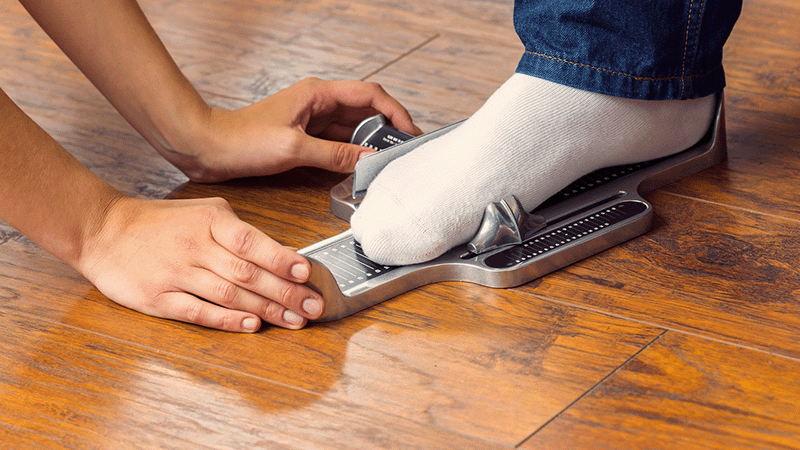
When it comes to finding the perfect shoe, knowing your foot size is a great first step. "We encounter individuals daily suffering from foot pain, bunions, callouses and hammertoes, often due to wearing incorrectly sized shoes," said PJ Calhoun, the manager at The Shoe Market. These ailments can be aggravated by wearing shoes that don't fit properly.
"When we offer to measure our customers’ feet, many say they haven’t been measured since they were a kid. Utilizing the Brannock Device — a tool that measures foot length, width and arch of the foot — is such a great starting point to get customers in a shoe that supports them properly and keeps them on their feet and comfortable.”
While some people may tolerate foot pain as a normal part of aging or from being on their feet all day, the reality is your feet don’t have to hurt. It's important to select a shoe that best fits your foot type. The Shoe Market offers footwear in multiple sizes from women’s 5 to 13, 2A to 4E, and in men’s from 7 to 17, 2A to 6E, so that customers can get the best shoe for their foot type and their everyday needs.
“There is no one style or brand that is perfect for every person. We have a large selection of quality, comfortable shoes to choose from and a knowledgeable staff to guide you to the proper shoe for your needs,” said Calhoun. “It’s all about getting the right fit for your foot size and shape, your foot conditions and your lifestyle.”
Here are some tips from the professionals at The Shoe Market to help you find the perfect shoe for your feet and your lifestyle.
Don’t get caught up on a number
Foot size and shoe size are rarely the same. Remember that shoes are made all over the world and that there are sizing variations among different brands.
Your feet change size and shape throughout your lifetime. Every time you purchase footwear, make sure you have both feet measured. Your footwear professional should take note of the length, width and arch length of both feet to make sure that the shoes that you purchase fit you perfectly. Did you know it’s common to have one foot that’s a little larger than the other? Pro tip: Make sure that you always fit the larger foot.
The details matter
Let your shoe fitter know about any foot conditions you may have, like plantar fasciitis, heel spurs, neuropathy or diabetes and how you intend to wear your shoes. Are they for everyday casual wear, running or walking, special occasions? Or do you work long days on hard surfaces? All these factors make a difference in the type of shoe you should be wearing.
Don’t be concerned with a little slippage in the heel. A rigid shoe will take time to flex and move with your foot. And there’s a good chance that a shoe that doesn’t slip at all is too short or too narrow and likely to cause blisters or other discomfort.
Your toes are meant to wiggle
Make sure that there is a finger’s width of room between the end of your longest toe and the end of the shoe and that your toes can move freely inside of your shoes. If you’re purchasing a lace-up shoe, make sure that the laces are in a straight ladder. Laces that come too close together often indicate a shoe that is too long or too wide, and laces that are too far apart often indicate a shoe that is too short or too narrow.
Hosiery and socks impact fit
Bring the hosiery or socks that you will be wearing with the type of shoe you are purchasing. Or ask for a try-on sock that best matches what you intend to wear with your shoes. Hosiery and socks make a big difference in how a shoe will fit and perform.
The Shoe Market has one of the largest shoe selections in the Southeast, with over 65,000 shoes in stock, and a full-service, experienced staff. Located in Greensboro, North Carolina, The Shoe Market has been family owned for over 30 years. For more information, visit theshoemarketnc.com.


